Mar 12

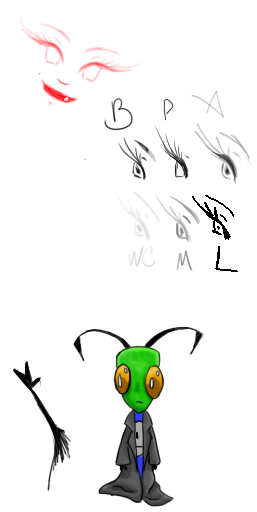
Playing with Paint Tool SAI. Friend linked me the English version so I’m playing with the trial to see if I like it.


Checking out the brush types and the rotation feature, etc.


Mar 9

Drew a comic yesterday while the internet was down. Click the picture for the full view.

Apr 26

Kaladea Notes

Sorry guys, these notes are kind of old but I don’t want to lose them if my laptop crashes again.

Creation Process:

Words from the mother-goddess creator:

“Awaken my child…”

“Are you the one who will lead this world to triumph, or to tragedy?”

“Brave soul, follow the path your heart sets for you and I promise you will do great things.”

“Your shining soul has been chosen out of many for incarnation into this world. Please choose your frame wisely.”

Tentative creation process:

Floating in the embrace of a warm darkness, you hear a woman’s voice call out to you softly, “Awaken my child…” her words seem to draw you downward. Below you a light appears and her voice emanates from the epicenter of that sun-like glow, “Are you the one who will lead my world into triumph?” As she speaks the word, triumph, images fill your mind of great kings, victory, peace and riches, “Or will you lead my world into tragedy?” as she speaks the word, tragedy, images of gruesome death, violent war, corruption, and greed flash through you. “My child, your shining spirit has been chosen of many of my children for incarnation into this world. Please choose your frame wisely.” At the utterance of the word “frame” the light envelops you and you stand in a square stone room with towering ornate pillars neatly framing a marble figure set in each shadowed archway.

((A faded nameplate at the base of each statue catches your eye. You notice strikingly different features for each statue and they each seem to be presenting you with a gift.))
(must look at each archway, look n arch, look s arch, etc. must look at the statues, look aria, look human, look northwood etc. once they look they can read, touch, tap whatever to get more information on each race. After they do that, to choose a race they simply take the item by accepting it.)

(Names are inscribed at the base of each statue. The statues hold an item toward you in their hands and it seems as if they present you with a gift. The aria statue presents to you a long silver feather. )

(Once the item is accepted (accept feather, ect.) they grow that body around them. And then the statue disappears and they walk through the door.)

A voice speaks softly from the darkness, “You have accepted this frame, come and make your offering.” You step through the archway and into (insert racial room here).

Room Aria:

A large open room with white oak pillars holding up the matching roof comes into view. The day’s sun shines in through the long flowing drapes of light green fabric that move in the gentle breeze. There lies before you a large bowl-shaped indent in the polished stone floor. As you draw near you see that the indent is deeper than you had thought, a large fire blazes in the center of the bowl.

“There is no turning back my child, release the spirit of your ancestors.” Comes the creator’s gentle voice carried on the breeze. The feather you hold in your hands feels suddenly as if it were made of lead.

(once they have dropped the feather into the fire)

The feather glows brilliantly for a moment before bursting into a million shards of light. The lights ricochet off the sides of the bowl and soar upward to form a large glowing eagle. The eagle of light lets out a loud screech and stretches its ethereal wings wide, surrounding you in the soft feathers of light. A gentle breeze seems to surround and flow through you. The floor fades from below your feet and you float gently on the eagle’s feathered wings toward what seems like a barren mountain cliff.

With a gust of wind from the ethereal wings you alight on the edge of the mountain cliff. Noises from below draw your attention to the city at the bottom of the valley formed by a strange ring-shaped mountain range.

(begin training sequence for the past!)

More About The Aria

The Aria are, of course, bird people. There are many types of bird people in the world, but they are all still the Aria, no matter which they take after. I’m thinking of having one specific kind of bird to model them after… what do you think? Hmm… Even with their wings tucked they would extend above the poor human body… Unless I attached them lower and made the wing-span different… Hmmm…. Where could I put wings on a human body that would not interfere with their range of motion? AHA! Most people attach wings to the shoulder-blades… Perhaps if I attached them just below there? Well, that takes care of the wing features, doesn’t it? What about the rest of them? There has to be more to them, they can’t just look like angels…

The Aria live in the… hmm… I still need to think of a layout for the lands. But a long time ago it was called the Western Peak. Yeah, that’s good.

Rocky hills and mountains with sheer dropoffs and cliff faces think the mountains in New Zealand or something, you’ll need reference pictures.
Minstrel/Bard/Troubadour

Levels of skills give the chance to learn certain songs/spells/abilities from the traveling circus man/men/women?

A traveling circus tours the island chain every once in a while and anyone who has taken up singing, or such godly troubadour skills may learn from the legendary (among bards, anyway) Ringmaster Armand Portious. (name in the works, I swear.) He is a master of vocal arts and magicks as well as optical illusion and sleight of hand (useful for thieves! Really!) that made him so famous as a magician. His troupe is made up of various masters of hidden arts, there is a siren that can teach you to sing a beast to sleep or complacency… You need only seek them out to discover what they can do.

I’ll think more about the Portious Troupe later, I’m sure I’ll be able to come up with a few new tricks that you can learn. *winks*

Armand Portious—Ring Master

Medina Raisher—Siren

Julius Berthold—Beast Master

Lisette Dekalb—Tight Rope Walker

Argus Montrose—Knife Thrower

Dresden Montrose—Knife Thrower’s Twin

Victor Raisher—Siren’s Son

Vesta—A strange young girl that Victor found and named

There obviously will be a plot line here… eventually… maybe there will be a reward or a quest gained by this troupe’s story.

Can you be exiled from cities and regions?

If I open up the world enough I’m sure we could work out being banned an exiled… If you were exiled I think it would be for repeat offenses of theft, offenses of treason and murder among many things. Too much stealing or dodging of bail could end in exile for an unlucky thief.

Alchemy/Herbalists/Medicines

Medical potions, spells, elixirs, draughts, salves, teas, ointments, powders, pills, herbs, roots…

All can be foraged or made or bought by characters. Certain plants and herbs are native to certain areas. Hooray for having to travel and adding place utility to items that are common. There will always be healing herbs that will be common to certain areas.

Maybe we could also add a way to get seed and grow things on your own once you have a house?

Special tools:

Mortar/Pestle

Bottles of various sizes

Vials

Jars

Oils and fats for binding

Catalysts

Pill Press

Accessories:

Herb Pouch (waist, holds some)

Herb Sack (Larger, waist)

Herb Pack (back/shoulder, largest “for serious herbalists only.”)

Herb Basket (arm/hand, holds more than a pouch but less than a sack.)

Apron (Waist, holds a few)

Strength/Effect:

Raw Herbs/roots

Dried Herbs/roots

Teas

Potions

Spells

Elixirs

Draughts

Salves

Ointments

Powders

Pills

Though the strength of effect varies depending on what it is made of and what it is created for. Pills are almost always most effective, but hardest to come by. They will sell well especially when created by players.

Herbs will have attributes and similarities to herbs in the real world. Advantages and disadvantages. Recipes for certain pills will be secret and hinted at in different locations. Perhaps even quest worthy. Like you can’t just find a recipe leaked out on the internet like this one (the pill one). They would need to complete something to be able to mix this pill. A certain level of skill, a quest that gives you access to a foraging spot that you can find the vital catalyst herb for it or something. Pills would likely be second world and above only, but they can be more useful than just your ordinary herbs.

Depending on the time period of the world, it would be next to impossible to have the pills in the first world.

I need to do research on ancient medicines!! That way I can have more ideas for mixes for just healing/poisoning. Maybe a bait for animals/beasts that if eaten can put them to sleep? Ooh, ranger powers.

More alchemical kinds of uses for the skills could be used to make small projectiles in the future world…. Hell there could even be an alchemy ‘class’ if you like.

Cooking ala Iron Chef

Should there be a far off land where through the game you can acquire recipes and use these recipes and things to compete against others in a cooking competition? Or perhaps be able to peddle your own goods to other players looking for foodstuffs.

Should you be able to open your own shop? Can you have your own restaurant? Or can you create a big operation from your own home’s kitchen? That would be great for certain things…

Skills for cooking? Well, I haven’t got any in mind… perhaps it should be stat based? Or stat and skill based for better odds? No, no burning down of buildings, but the charring of food is okay.

Collecting foods and things like in Suikoden 2? Or something better? Could you buy supplies from somewhere in different towns? And different towns have different meats and spices which you can collect and add to your repertoire? Would you have to cart them all to the city in which the competition is held? Or would you be able to have a house/summer home/vault in many different locations? Perhaps a global vault account that is more expensive?

Carl suggested that it could be an event or festival specific thing… It might work well that way.

Hana Fubuki – Working on Kaladea says:

Where you could wander around the festival booths and pick up recipes from the various food vendors and learn about spices and recipes and then se what you’ve learned to play a little Iron hef event heehee. Like when you enter the festival/event you can accept or decline a little festive notebook they would be handing out. It would record all the things you learned by wandering around and talking to people in it and you could use it for that event and maybe if the event repeats add new and different recipes on to your collection

You know there are days that I JUST feel like dying? Right now I just want to curl up in a bed and ignore the world for a while. I hate my period, it makes me feel so terrible. I get cramps, I get bloaty, I get gas and constipation, and I get horribly painful cramps,

People in STL:

  • Khademian
  • Gandylord
  • Farrar
  • Cosetta
  • Portious

Street Names in St. Louis:

  • Turnesa Lane
  • Trevillian
  • Trianon
  • Trillium
  • Tyrolean
  • Tullamoor
  • Demenil
  • Albion
  • Lami
  • Barton
  • Victor
  • Pierce
  • Bischoff
  • Hortus
  • Varrellman
  • Pomona
  • Marconi
  • Wise
  • Berthold
  • Devlin
  • Argus
  • Nox
  • Esther
  • Leola
  • Colletta
  • Tholozan
  • Nottingham
  • Lisette
  • Dresden
  • Oleatha
  • Osceola
  • Kealty
  • Julia
  • Dekalb
  • Cleon
  • Klocke
  • Vista
  • Juniata
  • Armand
  • Vanderburgh
  • Eads
  • Montrose
  • Ewing
  • Rutger
  • Papin
  • Gratiot
  • Albion
  • Hoehn
  • Jules
  • Cerre
  • Cole
  • New Ballas
  • Raisher
  • Medina


Random Definitions

Troubadour

One entry found for troubadour.

Main Entry: trou·ba·dour
Pronunciation: ‘trü-b&-”dor, -”dur
Function: noun
Etymology: French, from Old Occitan trobador, from trobar to compose, from Vulgar Latin *tropare, from Latin tropus trope
1 : one of a class of lyric poets and poet-musicians often of knightly rank who flourished from the 11th to the end of the 13th century chiefly in the south of France and the north of Italy and whose major theme was courtly love — compare TROUVERE
2 : a singer especially of folk songs

Main Entry: Oc·ci·tan
Pronunciation: ‘äk-s&-”tan
Function: noun
Etymology: French, from Medieval Latin occitanus, from Old Occitan oc yes (contrasted with Old French oïl yes) + Medieval Latin -itanus (perhaps as in aquitanus of Aquitaine)
: a Romance language spoken in southern France
- Occitan adjective


I want my city, the city of collared people, using collars as a marking of status within the city. I want the city to be divided by walls of varying heights and substances. The very inner walls will be shorter, weathered, and made of old stone. The outer walls will be huge impregnable things made out of iron and other such metals. The city itself is a city of continuing new developments while still holding to tradition. Perplexing, no?

I don’t have a name for this city yet, but I know that it will be a great one to work with. Outside of the city walls there is the outer city, or ‘the sprall’ (sprawl, mmm illiteracy, I can taste it now). The sprall is the slums of the city, it is inhabited by what are considered the untouchables.

The untouchables are not all terrible, they are simply poor. Like those within the city’s protective walls they have skills and special talents. They also sell unique items in their shops, hand made things to help them get by.

They are mostly a race of pseudo-humans of all colors (normal skin tones I mean).

There will be servant/slave collars for he important houses in the city. The nobles, or the higher ranking who own servants will have marks on the collars of their servants identifying whom it is they belong to. Ponder also stone collars for servants or collars magically attached so they are un-removable. Spell on said un-removable collars to allow them to grow with the person they are attached to.

These people are better suited for the magickal arts than other pursuits, but those pursuits are not denied for the sake of profit. Guild halls for all of the training needs can be accessed in this city.

Their bonus should be given to the stats that govern the magickal attributes, mentals or something like that.

I feel better when I’m being productive, rather than when I’m doing nothing. Even if it’s not my job I’m being productive at…


The Umbra—a non-player-character race (for now??) of dragon-like demi-humans. Their hidden city lies deep within the mountains and the forests on the mainland. In the history of the islands these people were long forgotten and passed into legend through the stories of a once ‘great’ hero. But they are alive and well still deep within their hidden underground city of (insert awesome name like Drakengaard here). The entrances to their city had all been sealed off after the great cleansing conducted by A’onar the Ruthless. Deciding that it was more beneficial to his children, the ‘father’ of the umbra sealed most of the entrances into the city and hid them away from the world at large. The city was ‘lost’ to the outside world. I could go on forever about the Umbra and their honorable warriors not too unlike samurai. (heh I could let Carl take care of the Umbra, think Drakonus love.. These would be the DR equivalent of S’kra-Mur but they’re not snakey people they’re dragon-ey people.)

Their underground city is, as detailed in my notes on the forest of illusion (name in works I swear it), unable to be entered by any normal means aside from going through the blatantly obvious entryway in the depths of the forest of whacked out-ness.

The Alterrans/Loamier/whatever in the hell we end up calling them

I want them to be a tribal people that aren’t exactly nomads but could be if they felt like it.

Apr 20

Of the four races of the world of Kaladea the one I’ve worked on the most so far is The Aria.

The Aria are a race of winged humanoids native to mountain ranges though their kind has spread throughout the lands. They prefer to live on the sheer cliff faces of the mountains. Their villages are hard to find and harder to navigate to on foot for other species, making the trade routes almost non-existent for those outside their kind. The lack of ‘contamination’ from outside sources has led to a very unique and close-knit society.

Read the rest of this entry »

Apr 19

Podrunner Intervals: http://www.djsteveboy.com/1day25k.html

Couch To 5k: http://www.c25k.com/

Just downloaded some ‘blank’ intervals that have no music mixes added. Thinking of downloading garageband or cooleditpro or some other audio program and making my own anime/bemani running mixes.

If I’m going to do something, I might as well enjoy it, right? So, why not make my own music mixes to accompany my runs when I start.

Dec 1

Okay, so NANOWRIMO is officially over! Everyone rejoice~!

Did you win? Did you ‘lose’? Did you come out just about in the middle?

Win or lose you’ve started on the steps of a great adventure and even if you didn’t hit 50,000 words in one month, you’ve started an epic journey that will make a great story so keep on writing.

I personally made it to 14,500 words before the end of the month, with half-assed writing and taking many breaks to do other things like watching Toradora and even watching Twilight and playing Fable 2. I’ll save my opinions about the Twilight ‘saga’ for another post/review.

I’ve started an epic tale, and I won’t stop until the plot arc is finished, 50,000 words or not.

Take care Wrimos and good luck on your next steps if you’ve finished your first drafts.

~Demosthenes

Nov 25

November is the month of the annual National Novel Writing Month when masochistic… er… motivated writers from around the world gather together (online) and try to reach individual goals of 50,000 words in one month’s time span.

I’m participating this year, and in previous years I made it only to 9,000 words before failing. It’s less about the quality of what you write, but more that you write as often as possible on one project and you push aside your judgmental feelings and urges to revise as you write your first draft.

As Americans, nay, as a people we have been taught from a young age that we are not allowed to make mistakes and we’re expected to be absolutely perfect from the first try. We have forgotten that it took us a lot of tries and trial and error and practice to become our ‘perfect’ selves.

NANOWRIMO reminds us that the first draft doesn’t have to be pretty, it doesn’t have to flow, it doesn’t have to have continuity and it can be full of plot holes. It doesn’t even have to make sense on the first read through.

The Writing Process Diagram

The Writing Process Diagram

The writing process that we learned as kids in school is soon forgotten and overridden by our almost obsessive need to be absolutely perfect in every way.

I’ve added in a diagram of the writing process to better help others understand that the process itself is important. From the first thought of the ideas of what you want to write about you’ve entered the Pre-writing process, you’re brainstorming and coming up with ideas you want to use in your piece. Thinking of points of interest that may catch the eye of the reader.

Soon your muse strikes and you get motivated and you begin drafting out what you want to become the basis of your story or paper. You might try writing out your major plot points or twists in more of a storyboard kind of manner and then arranging them as you see fit, but the moment you start writing you are drafting. This is where NANOWRIMO comes in, they urge you to put out your 50,000 word draft in 30 days. No skipping to the proofreading and editing part of the writing process, no revision, no re-writing.

It’s a very freeing experience to not have to worry so much about being perfect and let go and just let the story go off into the direction I always mean it to go before I go back and change my mind because I re-read parts and decided I didn’t like how they flowed. Without having to worry about revision right away it lets me focus on just getting that first draft hammered out and worrying about revisions and editing later. After all, that’s why there is more than just three steps in the process.

You will end up going back and forth between parts of the process as your story or paper develops and grows, but the most important thing to do is just finish your first draft. I always have let other things distract me from what I want to finish, but as long as I (you) work on it a little every day it’s not an impossible goal.

Don’t be scared of the 50,000 word goal, many Wrimos (NANOWRIMO participants) exceed their goal of 50,000 words as they get into the story as it develops and they feel the blockage of needing to rewrite fall away. There is a large support network made up of other participants and it’s not a competition, and everyone may or may not meet the 50k goal, some will exceed it.

Give it a shot, and you may surprise yourself.

~Demosthenes

Oct 29

Ladies and Gentlemen, I present to you the third part of the RP101 series. Part four will be posted in the next couple of days and I will be updating more frequently in the coming months.

~Demosthenes

RP101: (Part 3) Tree of Knowledge

by Wes Platt September 24, 2004


Of particular trickiness for a new roleplayer is the concept of what one knows out of character as opposed to what one knows in character. This distinction is known colloquially as the separation of IC/OOC.

In a text-based online roleplaying game such as OtherSpace, Chiaroscuro or Reach of the Empire, it’s extremely difficult to prevent Player A from finding out what happened to Player B or what Player C did to Player D. Players are able to page each other, talk on OOC channels, e-mail, and instant messenger. Staffers occasionally post logs of major events that involve specific groups of players so the entire playerbase can get a sense of what’s going on in a storyline. So, it’s important for players to distinguish between what the player knows and what the character knows.

Let’s think of all that information out there as the fruit of a tree of IC knowledge.

What staffers know exclusively can be considered the roots: The sort of information that isn’t likely to float around outside administrative circles.

What everyone knows forms the trunk, which everyone can see: Broad-based thematic information and IC news accounts about major events.

What individual players know can be seen as branches spiraling off from the trunk: Each branch is a single player’s perspective of events they experience.

Sometimes, during the course of a storyline, branches can become intertwined because separate players come together for a plot. For the duration of that entwining, the separate players share IC knowledge of events. But, once they drift apart, their experiences diverge along with their IC knowledge.

Problems arise when a player who only knows about something through an OOC source, without personally learning of it while in character, assumes they know the information ICly and then uses that information ICly.

For example: Player A walks into a dark alley, where Player B lurks and waits. Player B attacks Player A, beats him senseless, steals all his stuff and drags him to a warehouse to hold him as a prisoner. Player A is friends with Player C. Because Player A is imprisoned and isolated, he cannot share information ICly. But it’s possible to talk to people through OOC means. He tells Player C about his plight, revealing who mugged him and where he’s being held.

If Player C just commiserates OOCly, but takes no action himself without a purely in-character motivation, the line between IC/OOC is unbreached.

But if Player C takes that OOC information, attacks Player B and rescues Player A without any real IC motivation, the line between IC/OOC is shattered.

The only reason Player C should act on Player A’s behalf is if Player C learns about Player A’s plight through IC resources.

For example: Perhaps Player A tells Player C that he’s leaving on a trip to Destination 1 and that he’ll only be gone two days. After three days, Player A still hasn’t come back. At this point, it’s perfectly acceptable for Player C to visit Destination 1 to investigate, asking around about his missing friend. Maybe Player C’s investigation leads him to that dark alley and the waiting Player B. A scuffle ensues as Player B tries to mug Player C, but Player C prevails, subdues Player B and learns where Player A is being held.

Another problem may arise, however, if Player B abuses information obtained through OOC resources.

For example: Maybe Player B knows from reading logs on the website that Player A and Player C are IC friends. When Player C shows up in the dark alley, Player B drops out of character, leaving the IC grid to avoid the confrontation with Player C.

That’s a breach of IC/OOC.

When in doubt, ignore what you know behind the scenes and run with what your character knows. As important as it is to keep the player and character persona separate for mental health sake, it is just as important to keep separate what you know as opposed to what the character knows. It’s okay while watching a horror movie to yell at the screen “Don’t go down in the cellar!” because you know a monster’s waiting for the victim-to-be, but your input must be ignored. There’s no way the victim-to-be can know what you know outside the context of the movie.

It’s worth repeating: As a player, you may know much more than your character about what’s happening in the IC universe. Don’t abuse that abundance of information. Don’t assume you know things that your character hasn’t personally experienced or learned about through resources such as news outlets or other players’ characters in an IC context.

Channels, pages, @mail, e-mail, logs and instant messengers are OOC context; not IC. If you learn about something only through these methods, then you cannot, should not, must not allow that information to be used by your character ICly.

Your character should only use IC information gleaned from news articles, common knowledge sources, or interaction with other players.

Comments / Discussions about this Article

Wes Platt is the creator of OtherSpace: The Interactive SF Saga and Chiaroscuro: The Interactive Fantasy Saga. He’s a head-wiz on Star Wars: Reach of the Empire. (All games can be reached through his official site at www.jointhesaga.com.)

RP101 – copyright © 2004 by wes@Jointhesaga.com - All rights reserved.

Oct 5

Ladies and Gentlemen,

I present to you the second of six installments of a well thought out article entitled RP101. The original author of this piece is Wes Platt and was posted as an article on MUDconnect on June 5, 2004. Additional parts will be added to the blog shortly.


RP101 (Part 2) Taking the Stage

by Wes Platt June 5, 2004


Roleplaying, with its primal, deep-plunging cultural roots, gives people a chance to exercise their imaginations and participate in what-if experimentation.

So, let’s dispense right away with the myth that our text-based roleplaying environments are “just games.” They’re not. They do contain game-like competitive aspects, and they’ve even got referees for purposes of resolving in-character conflicts. But, at its heart, what truly sets a roleplaying game apart from roll-playing is the immersion of the player into an assumed identity as part of an evolving storyline. The story may be driven by staff-crafted plots, player actions, or a synergy of both. No matter what form of engine the storyline uses, the player’s assumption of a specific role within the saga is a constant.

In a true roleplaying game, the player takes on a job that is equal parts writer and actor.

Repeat after me: “It’s not just a game.” Keep repeating it until you’ve got it. I’m not sure you’re repeating it. In fact, it’s possible you don’t buy that premise just yet. After all, I’ve been referring to these environments as roleplaying games, so isn’t it contradictory for me to argue otherwise? No! Because I’m not telling you to convince yourself it’s not a game. I’m arguing that it’s not just a game.

What else is it, then?

  • Improvisational theater: Players interact in real-time, and bounce unrehearsed, impromptu actions and reactions off each other.
  • Creative writing: Players experiment with language, descriptive writing and dialogue.
  • Cheap therapy: Players can use the roles they play to work through frustrations and real-life issues.
  • Community: Players from around the world aren’t always “on stage.” Behind the scenes, friendships grow and communities are built.

So, roleplaying games offer potential to be far more than just the waste of time many detractors would have us believe.

Wait. Perhaps you hadn’t heard that roleplaying of this kind has detractors. Well, it does. Many of these detractors are also convinced that our true roleplaying environments are just games. They simply don’t understand.

Among other things, they think:

  • Roleplaying is a waste of time; hours and hours of your life you’ll never get back.
  • Roleplayers are geeks without lives.
  • Roleplaying without graphics is pointless.

I’ll address these misconceptions one at a time.

First, roleplaying’s not a waste of time. It’s an activity that takes advantage of modern global communication technology to hone creativity and social skills. It combines aspects of a traditionally solo activity, writing, and a traditionally social activity, theatrical acting. It gives players a chance to entertain themselves and others with minimal expense. In “the real world,” some people collect stamps, some sing karaoke, and some plant gardens. Their hobbies are no more valid for the expense of time involved than online roleplaying.

Second, all right, I concede that many roleplayers are, to some extent, geeks. Yes, you too are at least a minor geek. If you know words like “Telnet,” “blog” and “retcon,” then you have to admit at least a small percentage of geekitude. I’m a geek. I’m fine with it. But even geeks often have lives. Roleplayers come from many different walks of life. Very few of them, in my experience, are shut-ins. Most are high school and college students whose attendance waxes and wanes depending on homework, exams, school activities, vacations and dates – yes, dates! The adults who play often come from technological fields – information technology workers, Web customer service workers, computer repairs, web designers – but I’ve also seen law enforcement officers, soldiers, actors, journalists and artists. Almost all roleplayers I’ve met have lives, even if they frequently insist they don’t. Nevertheless, even if a specific player arguably has little social life in the real world due to their circumstances, the fact that they seek socialization in some form, even if it’s with a bunch of relative strangers via the Internet, is positive in my opinion.

Third, I’d argue that roleplaying with graphics doesn’t exist yet. Roll-playing with graphics, such as Everquest, Planetside and Star Wars Galaxies, makes for great eye candy. I’m not sure I’d want to spend $15 a month for the privilege to wander around a graphical version of a MUD, where socialization is minimal (usually limited to grouping for monster hunts), killing is rampant, and character development can only be gauged by increased experience points and improved skills.

So, it’s okay to roleplay. It’s not a complete waste of time. Those hours spent watching Star Trek: Enterprise, however, are hours you’ll never get back. You should have spent them roleplaying instead.

Now, one final point before we conclude this lesson: Although true roleplaying games are more than just games, it is imperative for the player to separate themselves from their character. Our hobby can become mentally unhealthy for players who fail to make this all-important distinction. The player is an actor who brings to life a character.

In that vein, consider an actor like Harrison Ford. His characters have included Han Solo, Indiana Jones and Jack Ryan. All three characters experienced triumphs and tragedies during the movies in which they appeared, and although Ford certainly imbued each character with emotion and personality, the actor is clearly distinguishable from the characters. What happens to those characters stays on the screen. You aren’t likely to find Harrison Ford lamenting how unfair it was that Han got frozen in carbonite and shipped off to Jabba the Hutt.

On the other hand, you’ve got actors like George Takei, who in recent years seems to have become obsessed with how much he deserves to command a starship. Er, wait, no, how much Hikaru Sulu, his character from Star Trek, deserves to command a starship in his own series. The line between actor and character is thinly drawn. It’s not a healthy situation. If Sulu got killed off, Takei would likely be the roleplayer who spins off the deep end, crying about the unfairness of it all and embarking on a campaign of truth to protest.

In a roleplaying game, it’s great for players to throw their energy and creativity into a character, bringing it to life. But for your own mental health, keep a clear distinction in your mind between the player and the character.

One rookie mistake that tends to foster confusion between player and character: Creating a character that is little more than an Internet puppet version of yourself. If you’re just playing you, then, naturally, you’re going to take it more personally when bad things happen beyond your control. Players who fail to make an adequate distinction between themselves and their characters are often the ones who end up complaining that they have to deal with bad things happening to them in real life, they shouldn’t have to deal with it in a game.

But, remember, it’s not just a game. Winning and losing aren’t the point. Developing a character and sharing a story: Those are the real points. Conflict, failure and strife are part of building character. So, if you don’t want those bad things to happen to you, don’t create yourself in a character’s shell.

It’s okay to imbue a character with some aspects of your personality, but you’re always better off creating a character that’s different enough so that when you log in and jump into roleplaying mode, you feel like you’re slipping on a mask and a costume. You’re not you when you take the virtual stage. You’re playing a character. One day, by your choice, by someone else’s choice, or by accident, that character’s going to be gone. Dead. Lost. Accept that now. Every story has an end. Make the most of these characters while they last, but understand from the outset that their existence is finite and separate from your own.


Wes Platt is the creator of OtherSpace: The Interactive SF Saga and Chiaroscuro: The Interactive Fantasy Saga. He’s a head-wiz on Star Wars: Reach of the Empire. (All games can be reached through his official site at www.jointhesaga.com.)

RP101 – copyright © 2004 by wes@Jointhesaga.com – All rights reserved.

Sep 28

I’m currently playing through Tree of Tranquility for a second time, my data from the first game was lost when my roommate left and took his Wii. I have one of my own now so I’ll have to rebuild everything I had before.

If you want to do your best in Tree of Tranquility you need to do your best to get the first rainbow completed before the end of first spring. It’s not an easy task but for veteran Harvest Moon players it should be a pretty straightforward list of tasks to complete.

Here’s a quick rundown of how your first season on the island should go, the information is courtesy of DetroitDJ on GameFAQs.com. Rewritten for the blog by me:

  • Pick up all tools (hammer, axe, fishing pole) on the first day you are released from training. You will have been given the hoe and the watering can by the grumpy looking man at Soufflé Farm.
  • Go to the river side of the root blocking the path to the Ganache Mine District to cue the cut scene to get that root out of your way, believe me the time cut off by that shortcut is significant. After the cut scene, head for the carpenter’s shop, then back to the tree root after all the cut scenes.
  • Meet all villagers as soon as possible, especially Maya (any sunny day at Waffle Town Square) and Mira (at the graveyard on any sunny day) as both will be vital in your mission. Maya will run a booth at the flea market with a goddess recipe ingredient, and Mira works in the blacksmith’s shop refining ores and gems you find in the mines, refined materials are worth more gold when you ship them.
  • Ship 2000g worth of products as soon as possible. Any products will do. Junk ore, unrefined ores and wonderfuls, herbs, shells, etc.
  • Gather the needed materials to upgrade your house once. This will take substantial stamina because your tools suck. Make use of the hot spring to refill your stamina. 18 wood and 16 stone total.
  • Save up some money for your house upgrade and for your oven. Try and ship at least 500g worth of goods per day. One trip to the mine ONLY picking up mushrooms and toadstools can get you over 1000g per day.
  • Collect the fish you need for the recipe, one carp, and several other fish to cook together to make good herb fish. The sell value of the fish used in the recipe determines the quality of the fish dish.
  • Keep a few herbs; you’ll need them to make the herb fish recipe in your oven.
  • On Spring 22 at the Flea Market pick up your Grilled yam and your apple needed for your goddess recipes. Also, if you have the extra gold pick up some Ostonnaise and an omelette here too. Those are used in later recipes and won’t be available to you for some time after spring 22.
  • By Spring 24 you should have your house upgrade under way. If you don’t start the upgrade on or before the 24th you may run out of time to complete the recipe.
  • As soon as you ask Dale to upgrade your house go and talk to Gill about the second half of the quilt (After your first 2000g the mayor should have talked to you about one half of the quilt). Once you talk to Gill, talk to Dale, and then talk to the mayor. Tell the mayor you’ll fix the clock tower and then head straight over there to get the second half of the quilt.
  • Once you complete the quilt, go up to the tree in the town square that has the harvest sprite’s flower beneath it and use your watering can on it. Trigger the sprite’s cut scene and get the recipe. You should already have all the ingredients, and if they are in your inventory just water the flower again to trigger the rainbow recipe completion cut scene.
  • Continue to save up your gold as the animal festival happens at the end of the season! You should pick up some yarns here even though they’re pricey. The rucksack upgrades will need them.

Rainbow #1 Recipe List:

Daren’s Rainbow

A. Good Herb Fish

  • Use 1-4 fish and any herb in your oven. The regular selling prices of the fish used should total at least 320g when combined with one another. A good combination is three carp, or three Masu Trout. If you’re not sure of the selling price and you’ve caught the fish, check your bookshelf and your fish list for more information.

B. Grilled Yam

  • Purchase the grilled yam (165g) from Maya at the Spring Market on Spring 22.

C.  Apple

  • Purchase the apple (225g) from Simon at the Spring Market on Spring 22.

D.  Common Seashell (NOT THE FANCY SEASHELL)

  • Find it on one of the beaches. It’s a random spawning forage item.

E. Carp

  • Fish it out of Maple Lake or Midstream/Downstream of the river.

Money Needed by Spring 28 (animal festival):

Oven – 2550g

Grilled Yam – 165g

Apple – 225g

House Upgrade – 3000g (18 wood, 16 stone)

Ostonnaise – 480g

Plain Omelette – 240g

4xGood Flax Yarn – 2160

4xGood Silk Yarn – 4200g

4xGood Wool Yarn – 1860g

For a total of 14,880g

The four of each type of yarn is for a straight jump up to a 25-slot rucksack once the tailor shop comes to town. You will need 2 good yarns of each type for a 20-slot upgrade and 2 Yellow Flax Yarn, 2 Red Wool Yarn, 2 Green Silk Yarn for the 25 slot upgrade. Buy at least two of each kind of yarn to jump to the 20-slot rucksack if you can’t afford 4 of each type of yarn. If all else fails, buy 4 flax, and two of the other yarns. You can always invest in sheep and silk worms to get the colored yarns. Flax yarn and flax seeds won’t be available again until after Taylor’s Seed Shop is set up in Winter Year 1, three seasons after the first rainbow appears. Or Spring of year 2 at least.

Tips for making quick cash early on:

  • Take daily trips to the mine to collect stacks of mushrooms (30g ea.) and toadstools (40g ea.)
  • Forage around the beaches, town, and forest for boosts to your cash flow.
  • Fish like your life depended on it when you have extra stamina. Not only do you boost your fishing skill and find recipe ingredients, you can sell off the un-necessary fish. Remember: grilling the fish using a match set and a stack of wood boosts the selling price of the fish by 30g so if you have a little extra gold, invest in matches when you go fishing. Match Sets are pretty cheap.
  • Another option for the grilling impaired is to invest in a Cutting Board and make Marinated Mushrooms (mushrooms and an herb on the cutting board). One herb, one mushroom, sells for 320 gold each. The color herb used will affect the price but the 320g is achieved with a green herb and a mushroom. (Again, only if you have the extra gold to spare on investing in a cutting board.)

Also, remember that in Tree of Tranquility items in your shipping bin don’t ship until you’ve slept, so you can use the shipping bin as a temporary storage to open up space in your rucksack until you get home and you can move things from your shipping bin into your toolbox or other storage device. Just don’t forget that you’re storing things in it or they will ship if you sleep.

Keep in mind that the most vital things for completing your first rainbow should be purchased first. Oven, House upgrade, etc. It’s a very tight schedule to keep to but with some determination it will work out for you. You might even want to make a few plates of ‘decent herb fish’ using one fish and one herb so you can restore your stamina while you’re out working. In a pinch, mushrooms will do for stamina restoration but they cause fatigue if you eat too many (around 10+) and they are also worth gold. Conversely, you could just sell the decent herb fish, but I’ve found that when I’m in a pinch it helps more than mushrooms. And it’s cheaper than buying onigiri from the Inn.

Good luck!

Demosthenes

« Previous Entries